
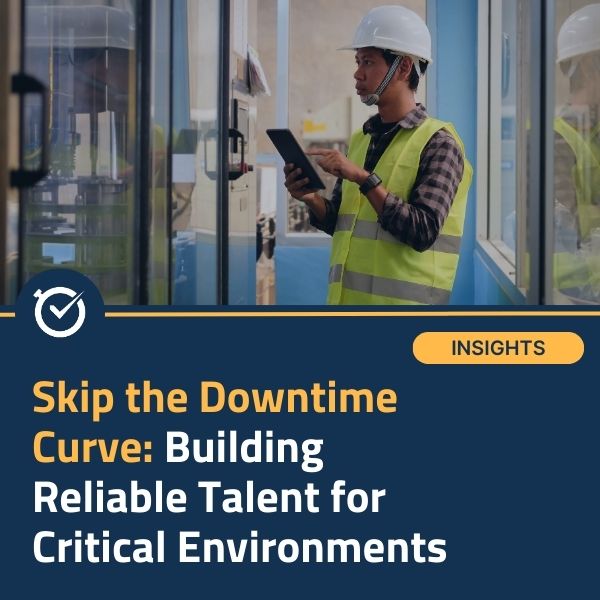
In mission-critical industries like data centers and semiconductor manufacturing, every hire comes with a hidden cost: the downtime curve.
That’s the ramp-up period when a “qualified” new hire is technically on the job but not yet pulling their weight. In a data center or semiconductor environment, that curve can last 6-24 months. Every hour in that period costs you productivity, budget, and sometimes even your reputation.
At Uptime Crew, we built our model to flatten that curve. Our approach is designed to deliver technicians who are not only technically skilled but ready to contribute at a much faster rate. Here’s how we do it:
Step 1: Mirror the Mission
We don’t believe in generic training. Every technician receives a foundation built around the actual systems, safety protocols, and compliance standards they’ll face. From CRACs and UPS systems to switchgear, fire suppression, and regulatory checks — our preparation reflects the realities of mission-critical environments.
No training can fully replicate the unique machines or layouts of every facility. But what we can do is ensure our crews arrive with the knowledge, safety mindset, and operational discipline to integrate quickly and reliably into your environment.
As Aaron Ritchie, SVP Solutions explains:
“We customize our training to match each client’s unique environment. The goal isn’t to simulate every single machine, but to prepare technicians with the knowledge, processes, and safety culture they’ll need to succeed.”
In practice, this means when our technicians walk into your facility, they’re not starting from scratch. They arrive with the fundamentals already in place — confident in their knowledge, grounded in compliance, and ready to maintain the reliability your operations demand.
Step 2: Pressure-Test Technicians for Mission-Critical Readiness
Knowing the steps is one thing. Executing them when it is 3:00 a.m., alarms are blaring, and the clock is ticking is something else entirely.
We design our training to replicate the pressure of real-world scenarios – even in a virtual environment. Through guided simulations and scenario-based exercises, trainees work through critical challenges like unexpected system failures, urgent maintenance situations, and tight time constraints. These exercises go beyond technical skills-they build composure, communication, and problem-solving under pressure.
One client told us that Uptime Crew technicians integrate more quickly because they have “already been through the fire” in training. That resilience shows. Technicians are more confident in their decisions, less likely to panic under stress, and better able to coordinate with their team during urgent situations.
When the first time you face a crisis is not the first time you have practiced it, you are not just better prepared – you are faster, safer, and more effective.
Step 3: Hire for the Crew, Not Just the Role
Technical skills are essential, but in data center and semiconductor environments, mindset and teamwork can be the deciding factors between smooth operations and costly mistakes. That is why we prioritize crew mindset in our hiring process.
We assess candidates for reliability, communication skills, and the ability to pull through a tough shift without letting performance slip. Cultural compatibility is not a “nice to have” -it is a requirement.
This approach pays off. Our retention rates are over 90 percent, exceeding industry norms. In many cases, our technicians are not only staying but moving up quickly. One was promoted to a competitive day-shift role within months, beating out tenured staff because of his initiative and consistent performance.
When technicians fit the culture, they work more effectively with your existing team, adapt to your processes faster, and contribute to a more stable, high-functioning environment.
Step 4: Deliver Proven, Not Promising
We do not deploy data center or semiconductor technicians based on potential alone. Every candidate goes through a multi-stage vetting process that includes technical assessments, knowledge training, and performance benchmarks set by industry veterans.
Only those who meet or exceed our standards are sent to client sites. The results speak for themselves:
- 66% faster time-to-productivity
- 90% + higher retention rates
One manager ranked our technicians among the top three performers on his entire team -a team that included full-time, tenured staff. Others have praised their initiative, noting that they volunteer for tasks, require minimal supervision, and even help newer engineers onboard.
These are not just capable workers. They are high-value contributors from the moment they join your operation.
The Hidden Costs of the Downtime Curve in Data Centers and Semiconductor Facilities
If you have been absorbing the costs of the downtime curve, you know they go far beyond a few weeks of slower output. They include:
- Lost productivity: Senior staff pulled away from their own responsibilities to supervise, troubleshoot, or re-do a new hire’s work.
- Higher turnover: Unprepared hires burn out or leave, forcing you back into the costly hiring cycle.
- Increased risk: Mistakes during the ramp-up phase can trigger safety incidents, equipment failures, or downtime events.
- Reputational damage: Clients and stakeholders remember missed deadlines and outages long after the issues are resolved.
- Missed opportunities: Delays in bringing new facilities or systems online can mean lost revenue and competitive disadvantage.
By the time a traditionally hired technician reaches full productivity, the cost of that lag has often outweighed the savings of the original hire.
Why This Works
Our approach eliminates the most expensive and disruptive parts of the technician onboarding process for mission-critical industries. By investing in readiness before deployment, we help you:
- Avoid weeks or months of shadowing that drain your senior staff’s time
- Reduce trial-and-error mistakes that put uptime at risk
- Retain more of the talent you have invested in
- Scale faster and with more confidence
This is not just about filling a position. It is about ensuring every new technician is a net gain from day one.
Your Playbook, Our People
We call it skipping the downtime curve. You will just call it getting the job done without the wait.
Uptime Crew. Trained. Committed. Reliable.