
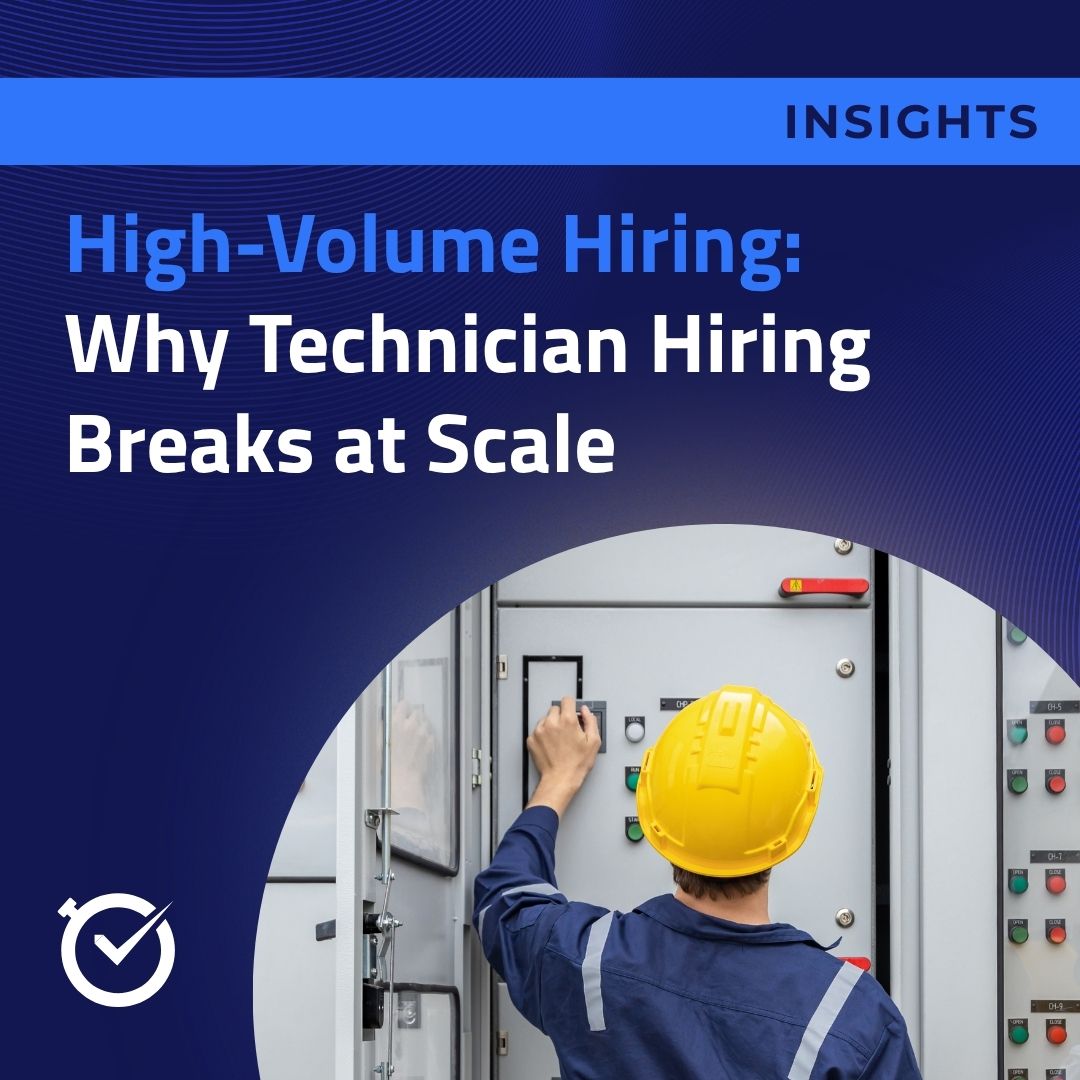
Hiring technicians at scale sounds manageable from a distance until you are trying to staff a rapidly expanding data center operation. Or support a semiconductor fab running 24/7. Or deploy field service engineers across multiple sites where every delayed install impacts production schedules, uptime, or customer trust. That is when the reality hits.
The problem no longer is about headcount. It is about operational readiness. Because in critical environments, hiring volume creates a different kind of pressure. You are not hiring people to sit behind dashboards and talk strategy. You are hiring people into environments where precision, process discipline, safety, and consistency matter every single day.
And when technician hiring ramps up quickly, the cracks show fast.
1. The Demand Curve Moved Faster Than the Talent Pipeline
The growth happening across semiconductor fabs, AI infrastructure, data centers, and critical facilities has created a technician demand problem most companies were not prepared for.
Entire markets are scaling at once. More facilities. More deployments. More maintenance demands. More uptime expectations.
The issue is that experienced technician pipelines were never built to scale this fast. Which means companies are now competing for the exact same pool of experienced field service engineers, data center technicians, and infrastructure operators.
That pressure shows up quickly:
- longer hiring cycles
- increased poaching
- wage inflation
- delayed deployments
- operational strain on existing teams
Posting harder does not solve it. At some point, companies realize the local workforce does not expand on demand.
2. Hiring Managers Want “Experienced” Because Downtime Is Expensive
In operational environments, hiring mistakes carry real consequences.
A weak install can delay production. A missed process step can create safety risk. A poorly trained technician can slow down the entire team around them. So naturally, hiring managers look for technicians who can contribute immediately.
The problem is that every company wants the same thing at the same time. Which creates a hiring cycle where organizations keep recycling talent from competitors instead of expanding the workforce itself.
That is not a scalable strategy especially in industries where uptime, yield, and deployment speed directly impact revenue.
3. Resume Matching Does Not Predict Operational Performance
A technician may look qualified on paper and still struggle inside a real operational environment because the work is not just technical.
It is procedural, environmental, behavioral, and situational.
- Can the person follow process under pressure?
- Can they communicate clearly during escalation events?
- Can they operate safely around critical systems?
- Can they adapt to overnight shifts, travel schedules, cleanroom expectations, or structured operational environments?
Those are much harder things to measure through traditional hiring methods alone especially at high volume. In industries where uptime matters, operational discipline matters just as much as technical skill.
4. High-Volume Hiring Creates Operational Drag
This is the hidden cost most companies underestimate. When large groups of technicians require extensive ramp-up time, experienced operators absorb the burden.
They train, shadow, correct mistakes, monitor work, and handle escalations which means the very teams companies are trying to support often become slower before things improve.
In critical infrastructure environments, high-volume hiring without operational readiness can create more strain before it creates stability.
That is why companies increasingly care about:
- accelerated readiness
- procedural discipline
- safety conditioning
- coachability
- consistency under pressure
Not just whether someone can pass an interview.
5. Technician Hiring Has Become a Retention Problem Too
Many companies still think about technician hiring as purely a recruiting challenge. It is increasingly a retention challenge.
Technicians today have options especially across:
- semiconductor fabs
- data centers
- AI infrastructure
- advanced manufacturing
- field service operations
If onboarding feels chaotic, operational culture feels inconsistent, or technicians feel unprepared once deployed, turnover happens quickly., and turnover inside operational environments gets expensive fast.
Because every departure creates:
- retraining cost
- lost continuity
- added workload for existing teams
- delayed operational stability
In high-accountability environments, consistency matters.